
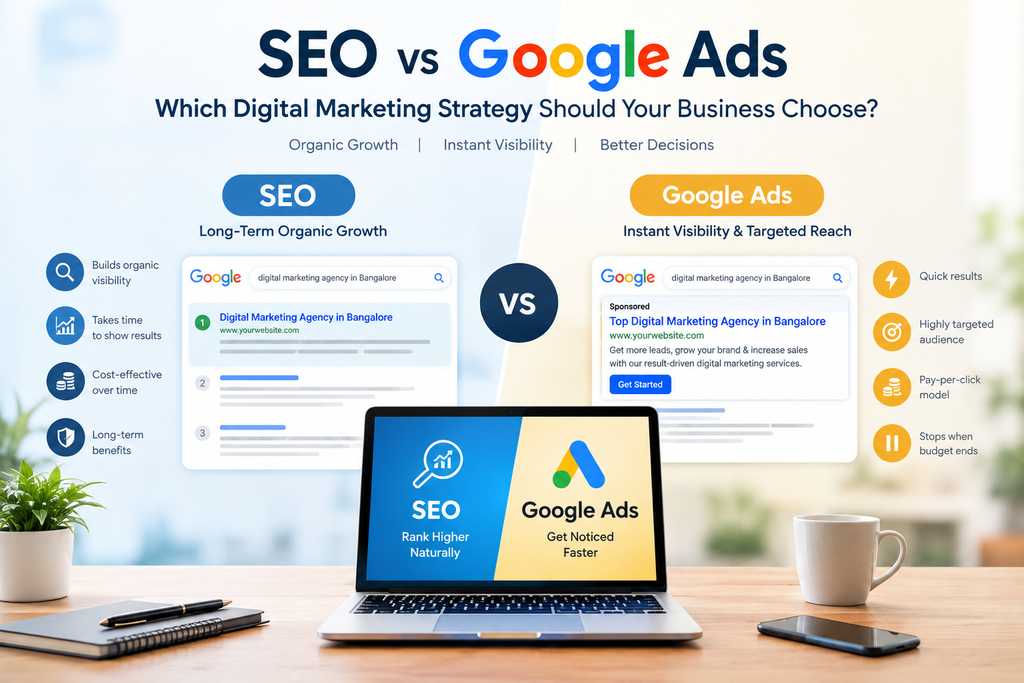
SEO vs Google Ads is an important comparison for businesses deciding how to invest in digital marketing. When people need a product or service, one of the first things they often do is search online. Businesses therefore need a strong digital presence to make sure potential customers can discover them at the right time. Two of the most widely used strategies for reaching customers through search engines are Search Engine Optimization (SEO) and Google Ads.
Both strategies can help businesses attract website visitors, generate leads, and increase sales. However, they work in very different ways. SEO focuses on improving a website’s organic visibility in search results, while Google Ads allows businesses to pay for advertisements that appear for relevant searches.
SEO vs Google Ads: Understanding the Key Differences
Search Engine Optimization (SEO) is the process of improving a website so that it can appear more prominently in organic search results.
When someone searches for a product, service, or question on Google, the search engine analyzes many factors to determine which pages are most relevant to the search.
SEO can involve several activities, including:
- Keyword research
- On-page optimization
- Technical SEO
- Content creation
- Internal linking
- Local SEO
- Website performance improvements
- Link building
- Image optimization
- Improving user experience
What Are Google Ads?
Google Ads is Google’s paid advertising platform that allows businesses to display advertisements to people searching for relevant products and services.
For example, if someone searches for “digital marketing agency in Bangalore,” businesses running Google Search Ads may have their advertisements displayed near the top of the search results.
Advertisers typically set budgets, choose targeting options, select keywords, and create advertisements. Depending on the campaign type and setup, businesses can track metrics such as clicks, conversions, cost per click, and cost per conversion.
One of the main advantages of Google Ads is that businesses can start generating targeted traffic without waiting for organic rankings to develop.
SEO vs Google Ads: The Main Difference
The simplest way to understand the difference is:
SEO focuses on earning organic visibility, while Google Ads focuses on paid visibility.
With SEO, you invest time and resources into improving your website and content so search engines consider your pages relevant and useful.
With Google Ads, you pay to participate in an advertising auction and potentially show an advertisement when your targeting matches a user’s search or other relevant signals.
Both approaches can bring valuable traffic, but the way you acquire that traffic is different.
Speed of Results:
One of the biggest differences between SEO and Google Ads is the time required to generate results.
Google Ads can potentially start generating website traffic shortly after a campaign becomes eligible to serve. This makes paid search useful for businesses that want to promote a service, product, offer, or landing page quickly.
SEO usually takes longer. Search rankings can take time to develop, particularly for competitive keywords. The timeframe can vary depending on factors such as website authority, competition, technical condition, content quality, and the search query itself.
Therefore, businesses looking for immediate visibility may consider Google Ads, while businesses interested in developing organic search visibility over time may invest in SEO.
Cost Considerations:
SEO and Google Ads have different cost structures.
With Google Ads, businesses typically establish an advertising budget and pay for interactions such as clicks depending on the campaign and bidding model. The amount required can vary considerably depending on the industry, keywords, competition, location, and campaign settings.
SEO doesn’t generally require paying Google for every organic click. However, SEO still requires investment in strategy, content, technical improvements, tools, specialists, and ongoing optimization.
This means SEO should not be viewed as “free traffic.” It requires resources and consistent work to build and maintain organic visibility.
Long-Term vs Short-Term Strategy:
SEO is often used as a long-term digital marketing strategy.
As a website builds useful content, improves its technical foundation, earns relevant links, and develops organic visibility, individual pages may continue attracting visitors from search engines.
Google Ads is more closely tied to an active advertising budget. When campaigns are paused, the paid traffic generated by those campaigns will generally stop.
This difference makes SEO useful for businesses interested in building a long-term organic search presence, while Google Ads can be useful when businesses need immediate or campaign-specific visibility.
Targeting Specific Customers:
Both SEO and Google Ads can help businesses reach specific audiences, but they provide different targeting mechanisms.
SEO can target customers through relevant search queries, locations, topics, and content. For example, a local business can optimize its website for searches related to its city or service area.
Google Ads provides more direct campaign controls, depending on the campaign type. Advertisers can configure factors such as geographic targeting, keywords, audiences, devices, schedules, budgets, and other campaign settings.
For businesses with a clearly defined target market, these targeting options can be valuable.
Measuring Performance:
Both SEO and Google Ads can be measured, but the metrics are somewhat different.
SEO performance may be evaluated using:
- Organic traffic
- Keyword rankings
- Search impressions
- Click-through rates
- Organic conversions
- Leads
- Engagement
- Indexed pages
Google Ads campaigns can be evaluated using:
- Impressions
- Clicks
- Click-through rate
- Cost per click
- Conversions
- Cost per conversion
- Conversion rate
- Return on ad spend
Tracking the right metrics is important because website traffic alone does not necessarily mean that a marketing strategy is producing business results.
Should Your Business Choose SEO or Google Ads?
There is no universal answer.
SEO may be suitable if your business:
- Wants to build long-term organic visibility
- Has useful information or content to publish
- Wants to attract customers through search over time
- Is willing to invest consistently in website optimization
- Wants to reduce dependence on paid traffic over the long term
Google Ads may be suitable if your business:
- Needs targeted traffic quickly
- Has a defined advertising budget
- Wants to promote specific products or services
- Wants to test particular keywords or offers
- Needs measurable paid campaigns
However, businesses don’t necessarily have to choose only one.
Final Thoughts:
SEO and Google Ads are both valuable digital marketing strategies, but they serve different purposes.
SEO focuses on building organic visibility over time, while Google Ads provides businesses with a paid way to reach relevant audiences through search and other Google advertising channels.
For some businesses, SEO may be the primary focus. For others, Google Ads may be more appropriate for immediate campaigns and lead generation. Many businesses can also use both strategies together to create a more comprehensive search marketing strategy.
Rather than asking whether SEO or Google Ads is universally better, businesses should consider their goals, budget, competition, audience, and timeline. The right strategy is the one that aligns with the way your customers search and the results your business needs to achieve.