
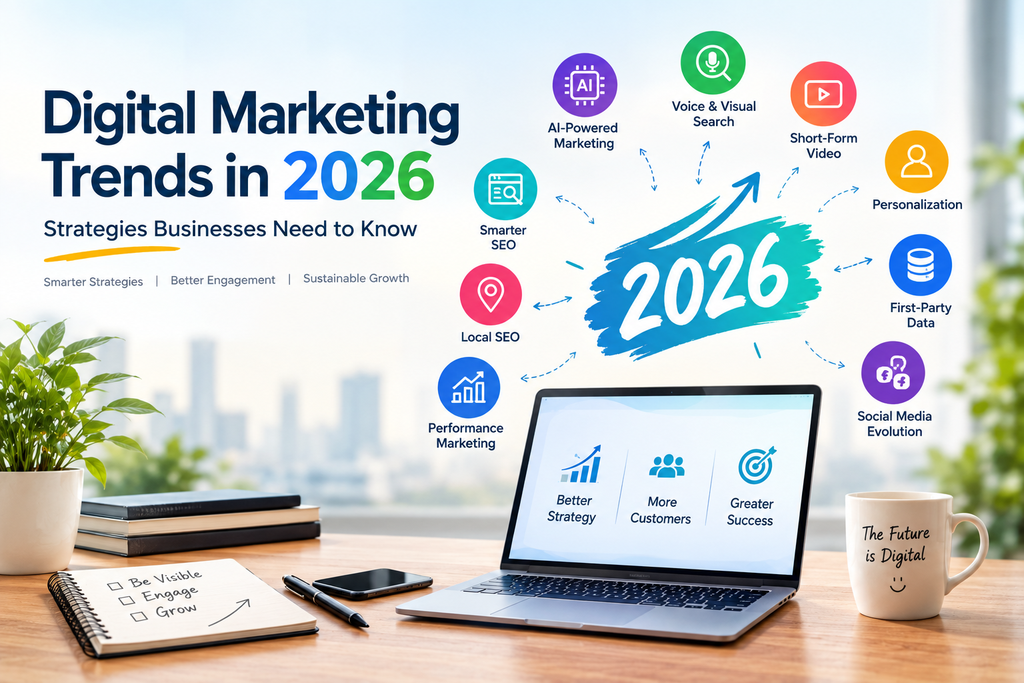
Digital marketing trends 2026 are being shaped by rapid changes in technology, customer behavior, and online platforms. Businesses are facing a digital environment where customers expect faster information, more personalized experiences, useful content, and convenient ways to interact with brands.
Digital Marketing Trends 2026: Key Trends to Watch:
1. AI Is Becoming a Bigger Part of Digital Marketing
One of the biggest Digital marketing trends 2026 is the growing use of artificial intelligence to improve marketing efficiency and customer experiences.
Artificial intelligence has become an important part of modern marketing. Businesses are increasingly using AI-powered tools to assist with content creation, customer research, data analysis, personalization, and campaign optimization.
AI can help marketers analyze large amounts of information and identify patterns that may be difficult to find manually. It can also assist with generating content ideas, creating variations of advertisements, and understanding customer behavior.
However, businesses should not depend entirely on AI-generated content. Human expertise, originality, accuracy, and brand identity remain important. The most effective approach is often to use AI as a supporting tool while keeping strategic and creative decisions under human control.
2. Search Is Becoming More Diverse
Search behavior is changing. People are no longer relying only on traditional text searches to find information. They may use voice search, visual search, social platforms, and AI-powered search experiences to discover products, services, and information.
This means businesses need to think beyond simply adding keywords to webpages. Content should provide clear, useful answers and make information easy for both users and search systems to understand.
For local businesses, optimizing information such as services, location, contact details, and customer reviews can also help improve their visibility when people search for nearby businesses.
3. Short-Form Video Continues to Matter
Short-form video remains an important format for attracting attention online. Platforms such as Instagram, YouTube, and other social networks provide businesses with opportunities to communicate their message through quick and engaging videos.
Businesses can use short-form videos to:
- Demonstrate products
- Explain services
- Answer common questions
- Share customer experiences
- Show behind-the-scenes content
- Introduce team members
- Share industry tips
The goal should not simply be to create videos because they are popular. Businesses should focus on creating content that is useful, entertaining, or relevant to their target audience.
4. Personalization Is Becoming More Important
Customers are exposed to a large amount of marketing content every day. Generic messages can therefore struggle to capture attention.
Personalization allows businesses to make their communication more relevant to different audiences. This can include personalized email campaigns, product recommendations, advertising messages, landing pages, and offers.
For example, an ecommerce business may recommend products based on previous customer interactions, while a service business may create different content for different customer segments.
The key is to use customer information responsibly and provide genuine value rather than making personalization feel intrusive.
5. Businesses Are Focusing More on First-Party Data
Data has always been important in digital marketing, but businesses are increasingly paying attention to information they collect directly from their own customers and audiences.
First-party data can include information from website interactions, customer inquiries, purchases, email subscriptions, and other direct interactions.
Businesses can use this information to understand customer preferences, improve communication, measure marketing performance, and develop more relevant campaigns.
Having a clear data strategy can help businesses make better marketing decisions while maintaining transparency about how customer information is collected and used.
6. Social Media Is Becoming More Than a Branding Channel
Social media is no longer used only for posting updates and building awareness. Businesses can use social platforms to communicate with customers, demonstrate products, answer questions, generate leads, and support sales.
Social media content can also influence how customers perceive a brand before they visit its website or contact the business.
For this reason, businesses should focus on maintaining consistent branding, responding to customers, and creating content that reflects their expertise and values.
7. Performance Marketing and Measurable Results
Businesses are becoming increasingly focused on measurable marketing outcomes.
Instead of looking only at impressions or likes, marketers are paying attention to metrics such as leads, conversions, customer acquisition costs, conversion rates, and return on advertising spend.
Performance marketing strategies can help businesses connect marketing activities with specific business objectives. This makes it easier to identify which campaigns are producing meaningful results and where budgets may need to be adjusted.
However, businesses should choose metrics based on their actual goals rather than focusing on numbers that look impressive but have little connection to business growth.
8. Local SEO Remains Important for Local Businesses
For businesses serving customers in a specific city or region, local SEO continues to be an important digital marketing strategy.
Customers often search for businesses using location-based queries such as “digital marketing agency in Bangalore” or “restaurants near me.”
Businesses can improve their local presence by maintaining accurate business information, optimizing relevant website pages, creating location-specific content, and encouraging genuine customer reviews.
A strong local SEO strategy can help businesses become easier to discover when potential customers are actively searching for their products or services.
How Businesses Can Adapt to Digital Marketing Trends in 2026
Businesses don’t need to adopt every new trend immediately. Instead, they should identify the strategies that align with their audience and objectives.
Start by understanding your customers and how they search for information. Review your website, SEO performance, social media presence, advertising campaigns, and content strategy. Then identify areas where improvements could have the greatest impact.
Keeping up with digital marketing trends 2026 can help businesses adapt to changing customer expectations and make better use of digital channels.
Final Thoughts:
The digital marketing landscape in 2026 is being shaped by AI, changing search behavior, short-form video, personalization, first-party data, social media, performance marketing, and local search.
However, technology alone does not create an effective marketing strategy. Businesses still need to understand their customers, communicate clearly, provide useful content, and measure meaningful results.
The businesses that adapt thoughtfully to changing digital behavior while maintaining a strong focus on customer needs can create a more effective and sustainable online presence.